History of I Wish I Was a Single Girl Again
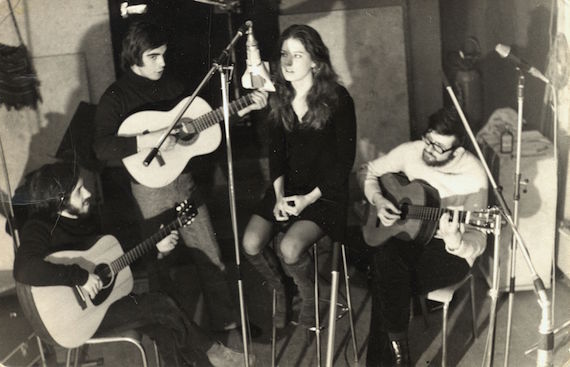
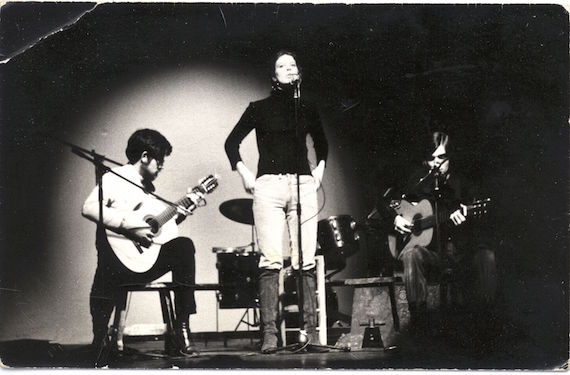
Christiana Wallman passed away in June in Pinehurst, North Carolina, at the age of 63. Those who know about the anthology she recorded nether the name Tia Blake take long puzzled over her backstory, which in some ways, is just as hazy and enigmatic as the music she made. Here are some stray details: she was born in Georgia to a father who may have been a CIA agent and a mother, Joan Blake, who would go on to found the Canadiana landmark that was Double Hook Bookstore in Montreal. She herself spent most of her life as a writer (article in Granta, play at the New York Fringe Festival), just very briefly, she refashioned herself a folk chanteuse in Paris. It was there, circa 1970, that she fell in with a group of musicians and cutting an LP of folk standards for a modest and unglamorous-sounding French label,Société Française de ProductionPhonographiques. Such was the calibration of the production, in fact, that a number of copies were misattributed to 'Tia Blake and His Folk-Grouping' despite Blake's cute visage appearing on the album cover. There followed a lonely gig at the famedThéî¢tre du Vieux-Colombier, then a relocation to Montreal, then a few tracks (never used) laid down in a CBC studio–and that was all, the stop of Tia Blake as a recording artist.
Nonetheless, Folksongs & Ballads, despite its throwaway championship and the transparent objective (pretty American in Paris sings a bunch of tunes in the public domainî laaméricain) is anything merely run of the mill. For all intents and purposes, an album of songs lifted directly from the Peter, Paul and Mary songbook–produced at a time when the Sixties folk revival had long run its class–should be little more a coffeehouse curio. And yet, what we hear on this tape is remarkable, sometimes hauntingly so.
What haunts us is the melancholy richness of Blake's voice, simultaneously whisper-soft and earth-weary. It helps, too, that she and her band seem to know their Francoise Hardy most too every bit their Joan Baez. If the repertoire seems to imply a earth of pre-Bob Dylan postcard folk, the songs themselves play out like post-Sound of Silence, mail service-Songs from a Room letters home–intimate, lonely, low-primal, shot through with onetime schoolhouseennui. Throughout, we hear a young adult female far from home, having learned all too well that blues run the game. Yes, it may sound as innocently makeshift as a Brill Edifice demo, merely its a naiveté (Blake was just nineteen at the fourth dimension) that manages somehow to get under the old, worn-out pare of these songs.
Case in point: Blake'due south rendering of "Children Go Where I Send Thee." As in the Peter, Paul and Mary version, the song is hither titled "Jane, Jane"–but gone is the background chant that accounted for the proper name change. All that's left is the modest primal arrangement, slowed to the pace of a nighttime stroll. In fact, when I outset encountered Blake's music through a Numero Group playlist featuring this song the effect was disorienting. I already knew this onetime spiritual, with its nursery-rhyme choruses, its surrealCuckoo-similar appropriation of folksong tropes. My grandfather used to sing information technology, my mother used to sing it. Tennessee Ernie Ford sang it. Nina Simone sang it. And however, listening to Tia Blake'due south downbeat version, fifty-fifty at the point at which she started singing familiar lyrics, I couldn't recall how exactly I knew what I was listening to. It was ghostly.
Tia Blake :: Jane, Jane
The guitars pluck away, lullaby soft, while a loping rhythm drives the tune further and further into dreamy territory: skip-rope prophesies, dogs that talk, cows that pray on Christmas morn. Only the thing that really startles is Blake's voice. The place-holder get-go line–Hey, hey my lord and lord–is delivered past Blake in the manner of a undercover, her easily cupped to your ear. It'due south a masterclass in understatement: ane breath, 1 line, and Blake is already leading u.s.a. into that slightly scary place where folksongs dislocate from time and place and become unknown quantities once more. Blasts from the past, maybe, but it'south a past too far back to recollect fully. Hence the ghosts, hence the haunting.
Something similar occurs during 'Plastic Jesus.' Here we take a jokey faux-trucker song that had get something of a folk club staple earlier Paul Newman wrenched the eye out of it inCool Hand Luke. What's surprising is that even though Blake doesn't come close to replicating Luke's bawling rendition, her laidback vocal still manages to locate something of the same lonesomeness in that melody (turning it into something Karen Black might take sung absentmindedly from the rider seat inFive Easy Pieces). The band is bouncing along beside her, just they never overtake the essential somberness of the vocal, a blahs that manages to speak volumes more than the dopey lyrics always could. Although 'Plastic Jesus' undoubtedly provides one ofFolksongs'lighter moments, it is, like the rest of this album, anything but lighthearted.
Runway for rail, the unselfconscious melancholy of Blake's voice quietly reclaims these songs. She quiets them down and airs them out in a way that few folkies dared (Jean Ritchie and Shirley Collins bound to mind, certainly–but by and large information technology's Vashti Bunyan, Sibylle Baier, and Nico you lot find yourself reminded of). Maybe recallLadies of the Canyon just turned downwards low at iv a.m. "Polly Vaughn" in such hands comes across every bit an atmospheric slice of psychfolk. "Betty and Dupree" is a play of low-cal and shadow, aBadlands story past way of Bridget St. John. "Hangman," meanwhile, re-supplies all the rejection and hurt that Led Zeppelin left off of "Gallows Pole"; again, it'south her voice calling us downwardly into the authentic grain of the song. Hearing her singslack your rope, Hangman, you can't help onlywitness the song's simple details from correct there on the scaffold.
Tia Blake :: Hangman
Some other stand up out is "Wish I Was a Single Daughter Again," a song which has been prone to plaintive, quondam-timey rocking-chair arrangements. The soft-footed Peter, Paul and Mary version provides a proto-"Blackbird" template here, but Blake's ring again softens the song upwardly fifty-fifty further, loosening its stride, giving its forlorn narrator a little more than living animate life than a unproblematic "bored housewife" cliché. Blake–without the slightest hint of pining–vocally lends the last few lines a thousand mile stare:
When a fella comes a' courtin' you, and sits you on his articulatio genus,
Keep your middle upon the sparrow that flits from tree to tree
And yous'll never wish you were a single daughter like me.
In Water Music's recently expanded edition of Folksongs & Ballads (culled from materials housed at the Southern Folk Life Collection, UNC Chapel Hill) a rehearsal tape of "Unmarried Daughter" ends with ane of the musicians request, 'Something like that, right?…That'due south the humor, the temper y'all want?'–and then there'southward sound of Blake's voice (again the nineteen-yr-old girl, maybe stifling a laugh at the use of the word 'humor') giving whatsoever easygoing aye. words / dk o'hara
Tia Blake :: Wish I Was a Single Daughter Again
martinezforut1955.blogspot.com
Source: https://aquariumdrunkard.com/2015/08/03/tia-blake-wish-i-was-a-single-girl-again/
0 Response to "History of I Wish I Was a Single Girl Again"
Enregistrer un commentaire